Sunday, November 25, 2007

goodbye


Day 12:

Instead of leaving for Brussels on Sunday morning as planned, I end up on a plane to Shanghai . . . I've always wanted to visit the city and I have the opportunity to meet choreographer Jin Xing, whom I have heard so much about. Something of a mythic figure in Chinese contemporary dance - a transsexual and former general in the army, Jin Xing created a dance company in Beijing before going on to establish her company and dance festival in Shanghai. As with most artists of interest in China, she's built most of this without government funding or support.

As the plane takes off Sunday evening, I have a great view of Beijing's bright city lights spreading out in all directions. As they slowly disappear I have the distinct feeling that this is a place I will be returning to in the near future.

Saturday, November 24, 2007

the show


Day 11: It's Saturday afternoon. The show starts at 3pm and at half past our guests start arriving. Our group is first on the program. Our performance concept is simple and everyone is ready. We keep the doors to the hall closed and as the guests start arriving the lobby begins to get crowded. We've prepared big bowls of mandarins, which some of the dancers start to distribute to our guests. In the main auditorium Young-Gyu is playing music he has composed out of sounds from the Miao village - an electronic musician, he's made an amazing track with a real dance vibe to it! It's pop and contemporary, but you still feel the Miao underneath it all. The music is playing full blast, so loud that you can hear it in the lobby through the closed doors.

We've created a score with several basic rules and everyone in the group can participate: The basic idea is to mingle with the crowd as they are entering the auditorium. The players can walk, run, fall, standstill, vibrate or shake, staying in one area for awhile before changing space to an opposite location in the room. We want to try to create micro-relationships with the public - localized performing zones for a few audience members at a time. Dividing up the auditorium space over 18 performers we try to create multiple points of view, where it is impossible to have a complete overview of what is happening. The goal is to try to create a disorienting situation for our visitors, both pleasurable ad disturbing, taking a familiar space (this is their theater after all, not ours!) and making it strange and unfamiliar.

At 3pm we open the doors and the guests start spilling into the noisy hall. We shake and vibrate as they enter. Our guests are amused and bewildered. Some try to avoid us, taking their seats right away while others stop to watch, many take photos of us while still others join in the shaking. The event is totally chaotic but a lot of fun. By the time we all start to move in unison they are cheering. The show has begun!

The other groups perform after us, each time followed by a speech from one of the artistic observers. Mei-Yin Ng from Malaysia does a great solo in the second piece with silver spoons attached to her, which make noise with each movement like the Miao costumes did. The group of Arco Renz work on a circular space structure where we can all join in, moving one circle inside another at a dizzying speed. At the end there is a long question and answer session with the spectators.

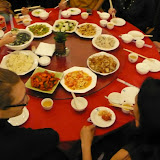
Champagne is served in the upstairs foyer and we are all happy to drink and relax a bit after all the craziness of the last few days. After the theater we are treated to a Mongolian hot pot dinner and more drinking in the Hutongs. Most of us are leaving the next morning and it's hard to say good bye . .


Guitarist Emanuel Bailey from Belgium, Choreographer Ezio Schiavulli from Italy and I post performance. And below a group shot with composer Joyce Koh, Jan Goossens of the KVS, dancer Wang Mei and Guqin player Wu Na from China and Belgian saxophonist Fabrizio Cassol.


A group shot together with some of the Chinese journalists who accompanied us on the trip.

theater in motion


It's our last day. After the morning session, I leave the group for lunch and run to the Sanlitun an hip area full of bars and night clubs that is in full swing development. I pass hordes of construction site workers having their midday meal.

Before leaving Brussels I contacted Els Silvrants, a Belgian who's been living and working in Beijing for a few years now. We meet in the bookworm cafe, a cozy place with lot's of secondhand english books, friendly ex-pats and wireless internet. Els tells me about her project Theater in Motion, a non profit organization that aims to build a context for the performing arts in China. Through TIM, Els has set up a research and residency space that offers international artists a place to work and meet other artists. Focusing on process, multidisciplinarity and the local context, TI also occasionally arranges workshops in the local academies, performances, as well as think tanks around problematics facing China's artistic community today. TIM is part of BeiLAB, itself a hybrid of organizations and individuals that functions as a hub and meeting place for artistic, architectural and scientific exchanges. Els tells me about the difficulties she faces running an independent structure in Beijing with little-to-no government support - a frustrating situation, but on the other hand, one that comes with the least amount of strings attached.

Friday, November 23, 2007

dress rehearsal


Day 10: It's been five days now since we returned from Guizhou. We've been working for four and at night we already have a dress rehearsal for the show. Everyone's feeling a bit pushed and pulled as we go from the intimate environment of our groups, where it feels like the work has only just begun, to putting things onto the stage. Choreographer Susan Buirge, one of our artistic advisers, takes the role of commander in chief, getting the group together and getting our work into form for the presentation tomorrow. The two other groups have been working more choreographically and, as we were all asked at some point to think about including the whole group in our work, they have been teaching us steps for the sections where we will join in. It's amazing that everyone has come up with so much material in such a short time!

Our group does a run though of our 'initiation ritual' in the lobby and auditorium. The others dancers and musicians join in. It looks a bit chaotic, but the advisers seems to have accepted that this will be our part of the event. The music of Young-Gyu get's us all into the mood. It's around 11pm when we finish and head back to the hotel. We stay talking until late in the hotel lobby. I fall into bed near comatose and wake up in the morning with my clothes on.

forbidden city


We have some time off this morning, it takes me awhile to get out of bed. I've been sick for most of the past week and I had a late night of drinking in the hotel lobby with Fabrizio Cassol, the great Belgian saxophonist and an artistic adviser on the trip. By the time I finally do stumble out of bed and go next door to have breakfast at McDonalds (I can't stand the thought of Asian food anymore), I have less than two hours to see the forbidden city. At over 1,000,000 square meters, the buildings alone account for an area of 170,000 square meters, two hours is not nearly enough time. I jump into a taxi anyway.

Arriving at Tiananmen square in the morning sunshine the place is crowded, mostly Asian tourists scatter over the square, lining up to see the Mao Mausoleum, or simply taking photos of themselves with his portrait in the background. I enter the gates to the city and buy myself a ticket. If you've seen the Last Emperor of Bertolocci you know a bit what to expect. Most will tell you that in real life it's a bit disappointing but I personally found it fascinating, especially the entrance procedure, you pass though one gate after another after another. In fact the whole palace is like a Chinese box , once past the gates, one throne room follows after the next, each one announcing itself as the center only to give way to another more important chamber.


I think the room below was the throne room of Emperor Puyi - at least it seems to be the room that was used in the last scene of Bertolucci's film . . .


Wednesday, November 21, 2007

798


Day 8: Work continues in the morning. We have some time off after lunch and most of us head over to 798 (Dashanzi factory district) to see the newly opened Ullens Center for Contemporary Art (UCCA). Established by Belgians, Guy and Miriam Ullens, both art lovers and avid collectors of contemporary Chinese art, the center opened it's doors this November with the aim of promoting contemporary Chinese art both in China and internationally. The first exhibition, '85 new Wave - the Birth of Contemporary Chinese Art, is an overview of the work of Chinese artists from the 80's and early 90's. The chronology that accompanies the exhibition is fascinating and definitely worth taking a look at. I was happy to find it on the exhibition web site, as it was absent from the catalog (see site link above).

Starting with the death of Mao in 1976 and the end of the cultural revolution, when China was not only cut off from the rest of the world, but was also forced to disown and renounce its own culture, the late 70's and early 80's in China is marked by the arrival of some 50 years of western art history. Walking into the exhibition you feel time vertically, a pilling up of different periods and influences. For some artists the influence of the heavyweights of modern art is clearly visible, while a few groups or collectives plunged right into a conceptual and activist approach. Still others took to the more commercial approach of 80's pop art, yet despite these influences, it's not a copy paste culture you feel, but rather one of appropriation, self-reflection and for the most part, a subversion of the western trends. The result are works that dialog with traditional Chinese arts on the one hand and with the Western canon on the other.

game plan


There are 18 participants in total on this trip, 9 from Europe and 9 from Asia, 6 musicians and 12 choreographers. I'm working together with (from left to right) choreographer Hartati from Indonesia, dancer/choreographer Tae-Sang and composer Young-Gyu from Korea, saxaphonist Athur Vidal from Spain/France and choreographer Ezio Schiavulli from Italy (not shown in the photo). Our group meets daily in the studios of the Chaoyang cultural center in Beijing. We have to prepare something for a public presentation in a few days time. We've been discussing for two days now: One thing is clear, we don't want to end up on stage making a modern dance interpretation of the Miao culture! Our experience has been so complex and interesting that we want to find a form that can best transmit this to a public.

We come up with a game plan for our part of the show. The details aren't clear yet, but we know for sure that we want to work with the whole of the theater including the entrance, lobby and auditorium. Rather than representing our experience on the stage the way the Miao were forced to represent their rituals as staged performances, we want to create an experience for ourselves and the public: a welcome and greeting ritual to initiate our visitors. We want to transform the theater, a space more familiar to our public than to us, into something strange and unfamiliar. We want to take it over for the space of the show and make it our 21st century village! We run though our idea with the other participants and they are enthusiastic - though convincing the project leaders proves more difficult . . . after many debates we are given the green light to develop the idea - we're looking forward to meeting our public in a few days time!

Tuesday, November 20, 2007

Back in Beijing


Day 6: Back in Beijing everything takes on a new perspective. After 5 days in the countryside I am almost too happy to back in the city! We head out to a super trendy restaurant in the evening for a bit of decadence. Pure Lotus serves great vegetarian dishes with names like 'I love you, no discussion' and 'endless sensuality', one a spicy eggplant dish and the other a tofu appetizer. The dessert takes the cake however as the waiter comes in with a bowl of mandarins overflowing with dry ice.

This city never sleeps - the construction sites work around the clock and I'm pretty sure the face of the city has changed significantly since we were last here 5 days ago. Not that I have much time to be out of doors, in the daytime we are busy meeting with the different artists in our groups trying to figure out what we will present in a few days time. A theater venue has been hired for us and we expect 200 - 300 people to attend our final presentation. Even though this should be an 'informal showing' we can't help feeling like people are expecting a big show. This puts a lot of pressure on us to produce something interesting. The trip has raised a lot of questions for most of us and we are all just at the stage of trying to figure out how to respond. But in art difficult questions are vital to producing anything worthwhile and so the discussions feel like a necessary and very stimulating part of the process.

Monday, November 19, 2007

culture and censorship


During the trip we were followed by several journalists and camera men, among them a camera guy who is documenting our visit for China Central Television. The daily newspapers in the region published articles with pictures of us dancing with the Miao. We must be making great promotional material for the local tourist industry. The feeling is double, we are having a great time and what we are seeing is very touching, but at the same time we can't help feeling that the people here need more than bus loads of tourists arriving on their doorsteps. On the road back to the airport we pass a recently renovated school and are told that an international agency helped to fund it's renovation. Quite a surprise that the funds came from abroad when you see how much money is being made in China today. You can see there's investment here, but is it for the right thing? At the airport we speak with one of the experts who made the trip with us. As an anthropologist, she is concerned with the preservation of the Miao tradition, however much of the money coming in for culture does not reach her. There are no local cultural centers being built and contemporary art and artists hardly come to the area except on culture tours like the one we are on. When you speak to contemporary artists working in China you begin to realize how little cultural funding there is here, outside of the major events such as the 2008 Olympics.

That's the least of the worries facing artists here however - censorship is very strong and not only on stage but also in life. One of the reasons I was not able to finish my blog while in China is because I had such a tough time accessing it - sites like blogger and flickr have been blocked since a few years now, and some news sites like the BBC are unaccessible. The three no no's are Taiwan, Tiananmen and Tibet - try writing about one of these and your email account might just go offline. When I asked a journalist traveling with us how he felt about freedom of the press he told me there were no written rules about what you could or could not write about but that everyone knew where the limits were. Working in culture he said he didn't feel these constraints so keenly, however it is clear that most art that is remotely political or critical happens underground and would never make the major papers.

Sunday, November 18, 2007

Next Generations


Day 5: Our trip continued with a visit to two more Miao villages in the Guizhou region. In the first we heard the most incredible singing so far on the trip, causing all of us to gather around with various recording equipment to catch the sounds. The dancing was also the most interesting to watch, the small steps replaced by wide fluid steps and swinging arms. Apparently the group came from another town and performed for us in a village that was not theirs. Were they professionals hired for the day? Impossible to get a straight answer from the local organizers. We were able to speak with some of the locals however, who watched on with some sadness telling us that they too had their own dances but had not organized themselves in time to show us something.

Between the morning and afternoon visits we stop off at a local school where a group of school children have prepared a dance routine for us. Their energy and enthusiasm is amazing. The kids dance in colorful costumes with a mix of traditional steps and contemporary rhythms. At the end of the show they are super happy to be photographed with us and speak to us in fragmented English, with some super funny results. One of the main problems in the region is how to preserve the Miao culture heritage? The gym teacher here teaches the Miao dances to his students as part of a new 'experimental' curriculum that aims to bring traditional folk arts from the region to the students.

The second and last village we visited gave the most touching and perhaps the most strange performance for us so far. In a basketball court beside the main road a makeshift performance space was set up with a leafy decorated gateway though which we had to pass. The villagers performed a ritual dance which included the killing of a duck and the sprinkling of it's blood in a semi circle, a ritual that we later learned they usually performed knee deep in the river. Apparently 500 years ago the town had prayed for water so fervently with this dance that they received a stream. They continued to perform the ritual ever since in order to honor their ancestors, even during the cultural revolution when they had to do so in secret. A few years ago the government built a dam that caused the whole town to be submerged in water. The villagers were obliged to move to this present location where they now look onto a dry field and a new housing development.


cultural displacements


It's been a few days since I last posted. The rate of change has been so fast that it is difficult to keep up with the flow of experiences let alone report on them. From one day to the next, from one moment to another the feeling and sense of everything is shifting. To keep a bit in order I will try to stick to the chronology, which might keep me a bit out of sync but it seems to be easier to write with a few days distance.

As our trip to Guizhou progressed the set up began to unravel - the visit to the villages, the minorities and their customs, gave way to the spectacle of a growing tourist industry and the mise en scene of a traditional culture rapidly facing the pressures of a modernizing world. In retrospect it was all to be expected, but when everything is so new it's hard to see the global picture because of all the details. And China is an overwhelming wealth of detail.

The fourth day we visited one of the largest Miao villages, over 1000 houses (5000 people), where we spent the second day of the New year's celebration. Our hosts organized a venue for us and initiated us into several Miao rights - killing a chicken for dinner, pounding sticky rice until it becomes a paste and drinking rice wine until you can't see straight anymore. At lunch time we had our most adventurous meal until now, including fried intestines, black chicken, pork fat dipped in chili paste and various wild vegetables.

In the afternoon some of us continued on with the program, visiting other Miao homes to drink more rice wine, while others went off to discover the rest of the village. The organization of the whole event and the blatant display of the Miao culture for us visitors began to feel uncomfortable and like many others I felt the need to take some distance. However, wandering the streets filled with handmade jewelery shops and embroidery sellers, it was impossible to escape it. Before I knew what was happening I found myself being dressed in a Miao headdress and skirt by a local street vendor. He led me into the central square and photographed me a dozen or so times, putting me into different positions against the backdrop of the village. In the same square I came across the camel I had seen being led down the street earlier that day. Standing in the middle of the crowd, he was probably brought over from the Gobi dessert as an attraction for the more local visitors. We didn't see any dance and music displays, but I felt like the whole town was performing itself at every turn.


Friday, November 16, 2007

Miao Minority


Day 3: The last two days have been a sort of build up towards today: For our visit to Guizhou, the cultural department of the local government organized several visits to small villages in the area to see traditional dance and musical rituals of the Miao people, one of the many ethnic minorities living in the region. Today we were able to visit two villages out of the four we will see on this trip. It was an amazing but also a bit unsettling experience.

This morning we left the hotel very early and drove several kilometers to a small village perched up on the mountains. The landscape here is quite impressive and very hilly, in fact 90% of the region is mountains and they say you can't drive three hundred meters without going up or down a hill. (Incidentally you also never get three days of sun in a row - we are on our second sunny day, so I am keeping my fingers crossed for tomorrow.) The ground in the region is very tough but despite the hard conditions the people here have managed to cultivate the land, and the hills have been terraced with rice paddies wherever possible.

Traditionally the Miao people earned their keep by growing rice and other vegetables, though today they seem to survive mainly on tourism. The region is still very poor and the tourist industry is still (luckily) not very developed, with the exception of our brand new mega hotel and the recent paving of the main roads. You definitely feel that a lot will change here in a few years time. The houses directly on the main roads are modern, while those set back from the road, like in the villages we visited are still made of wood following the traditional construction method, which does not use nails or screws.

In the first village we were welcomed by the local villagers who played their instruments from the top of the hill as we climbed. In order to enter the village we had to pass through a gate and drink several cups of rice wine from women standing at the entrance. A custom that kept repeating throughout the day, the goal of which seemed to be to get the guests as drunk as possible. On the central square they performed their traditional dances and sang traditional songs. The women and men wore beautiful costumes and headdresses, which made noise as they danced. One of the ways the villagers can earn money is by participating in dance competitions, and so in some of the dances you could feel the influence of Chinese modern dance along with some less highbrow dance forms.

We were able to visit the local farmers, in the home I visited we were invited into the summer living room, where the woman of the house brought us fresh raw sweet potato to eat. On the wall was a huge poster of chairman Mao, who the guide (a new one named billy), explained was a hero for the Miao people. He even sang us a Miao song in homage of the chairman. Indeed communism declares all people to be equal, a policy which raises the status of farmers and countryside workers who were previously considered to be lower class peasants.
And it does appear that in the mid '70's a policy was created which allowed the people to own and develop their land. (Until as recent as 2004 however it seems that they had to pay 15% of their incomes to the government in exchange. In relation to the growing income of the average city dweller this sum must have become absurdly low in recent years).

Despite the presence of communism, the villagers still seem to follow their own religious practices, which are centered on the role of the shaman to help protect them from evil spirits and bad fortune. In the houses we passed their were frequently bunches of dried sticks, roots and chickens feathers tied to the doors or in the corner of the rooms to ward of an illness or misfortune in the family. Could they have been placed there to ward off any bad luck visitors like us might bring to the village?


The second village was much much rougher and less scenic. Their proximity to the main road makes it an easier tourist site and the spirit there felt a bit more forced. We found out afterwards that the local government paid the villages to perform for us and it is not clear how much this actually benefits the locals.
One of the local women hinted that everything in the village was for sale, when one of the participants asked if they could show her how they tied up their hair. However when they learned that we were dancers and musicians and not the normal tourist fare they opened up somewhat and one of the elder women spontaneously performed an extra song for us. Luckily we are here within the week of their new year celebrations and tomorrow we will spend the day in a village during one of their actual rituals.

The goal of this trip to China is for dancers and musicians from Europe and Asia to visit the Miao people and for us to get to know their traditional culture. Upon returning to Beijing we will have a few days to work together in groups and to come up with a 'response' to the experience. What exactly this response will be is still a mystery to me, but for the moment it is definitely interesting to be here. The experience brings up many questions about traditional customs, practices and beliefs, if and how they can be preserved and what our contemporary relationship to them should be.


Thursday, November 15, 2007

Lee


Day 2: Started with a jolt with a 6 am wake up call and drive to the airport. I am still totally jet lagged, so I passed the day in a haze. I just don't manage to sleep in the hours that I should, I'm completely out of order. The air hostesses on the plane were immaculate in a way that makes me think of those films from the 60's. Seems it is quite a prestigious job for girls from the provinces and they even hold local beauty contests to hire the girls. We flew 3hrs (1980km) from Beijing to Guizhou. Upon arriving we were brought to the main town to have lunch with the local politicians in charge of culture who welcomed us to the district. The meal was 13 courses and was delicious, but by the end it was impossible to look at the food on the plate anymore. The title of this blog is becoming prophetic - it really starts to become an ordeal to eat three full course meals a day.

Weather upon arrival was sunny and + 20, we were told that this was a sign from the heavens that we were welcome, after rainy Brussels and Beijing I certainly felt blessed. After lunch we were bundled back into buses and had a 4hr ride to the village where we will be staying for the next three days. Our tour guide Lee talked non stop for most of the ride, telling us about the local customs of the region, which continues to actively use dance and music as part of their local celebrations and ceremonies. A Miao by birth, he spoke English quite well and seemed to enjoy speaking immensely. It was difficult however to follow all the details given the loud and bumpy bus ride along those small and winding roads. When we arrived in the village after several hours of countryside we found ourselves in a huge brand new 4 star hotel, it seems the Miao's must be getting a lot of visitors!

At dinner (another huge meal!) we had a chance to taste one of the local customs: two girls came round to each of the tables singing a welcome song accompanied by tiny glasses of sweet wine which they asked us to drink with them at the end of the song. Through the whole meal whenever you finished your small glass it was filled up immediately making us all more than a little tipsy at the end of the night. If it continues like this I think we will all be dancing and singing like the Miao before long!


Composer Joyce Koh from Singapore and Choreographer Cathy Seago from the UK at the Guiyang (Guizhou province) airport


Jan Goossens of the KVS with the water buffalo at a pit stop on the road


Jethro Pioquinto, a dancer form the Philippines taking a cigarette break after three and a half hours of driving

Wednesday, November 14, 2007

the hunt


The second day in Beijing and I have to say I didn't manage to get out very much. I am here for 12 days as part of a cultural exchange program between Asian and European dancers and musicians organized by the
Asia Europe Foundation and the China Dancers Association. Our first day started with a press conference with many formal speeches and a question and answer with the press, including incidentally a camera man from the omnipresent CCTV. As it turns out, the woman in blue seated at the central table is China's first 'white swan' (ie: China's first Ballerina), which makes her quite a celebrity! The second half of the day included presentations of all the participants who, coming from all over Asia and Europe, all have very different histories and backgrounds.

I slipped out for an hour during a tea break and went visiting the neighborhood. I tried to get a closer look at the Koolhaas construction site across the street but after walking around the entire block (which took more than half an hour), I concluded the best view was the one I had from my street corner the first night. The building site is surrounded by a huge empty billboard that completely blocks the view from the front, as if they don't want the building to be seen until after it's completed. I tired to sneak in at several entrance points but could only watch the flow of workers coming and going from the gateway. They say they work around the clock and I can believe it. The building looks suspiciously like the CCTV logo . . am I hallucinating?

Okay, I have a 6 am wakeup call so I'm gonna hit the sack. Tomorrow we are leaving for Guizhou a region close to the Yunnan province where there are still many ethnic minorities living a relatively undisturbed traditional lifestyle. I am very curious and will be sure to report!

xu

p.s. I tried to open a flikr site for all the photos, but many blog sites seem to be unaccessible. This one goes on and off from time to time, but so far so good. Seems they have a very strong internet surveillance team so I will try to keep away from any forbidden language . . .


The best view I could have was by sneaking in though a back parking lot. Does anyone else think it looks like a transformer?

Tuesday, November 13, 2007

chopstick diaries


I landed in Beijing this morning! I've never been to Asia before and everything is strange and wonderful. I can't help photographing all the things around me, as banal as they may be for the local passer by.

Supermarkets and shopping malls, even the airport seemed exotic. I almost got run over at a busy intersection trying to photograph the new CCTV building of Koolhaas, which is under construction across from my hotel.

So, as much as I've resisted this blog thing in the past, I could not think of a better moment, if ever to start one. Here it is - welcome to my chopstick diaries cLL

For those who want to follow my trip I'll try to update it as often as I find internet. It's getting close to midnight and I will have been up for over 24h so I will leave the prose for tomorrow and just post some picts.

xu